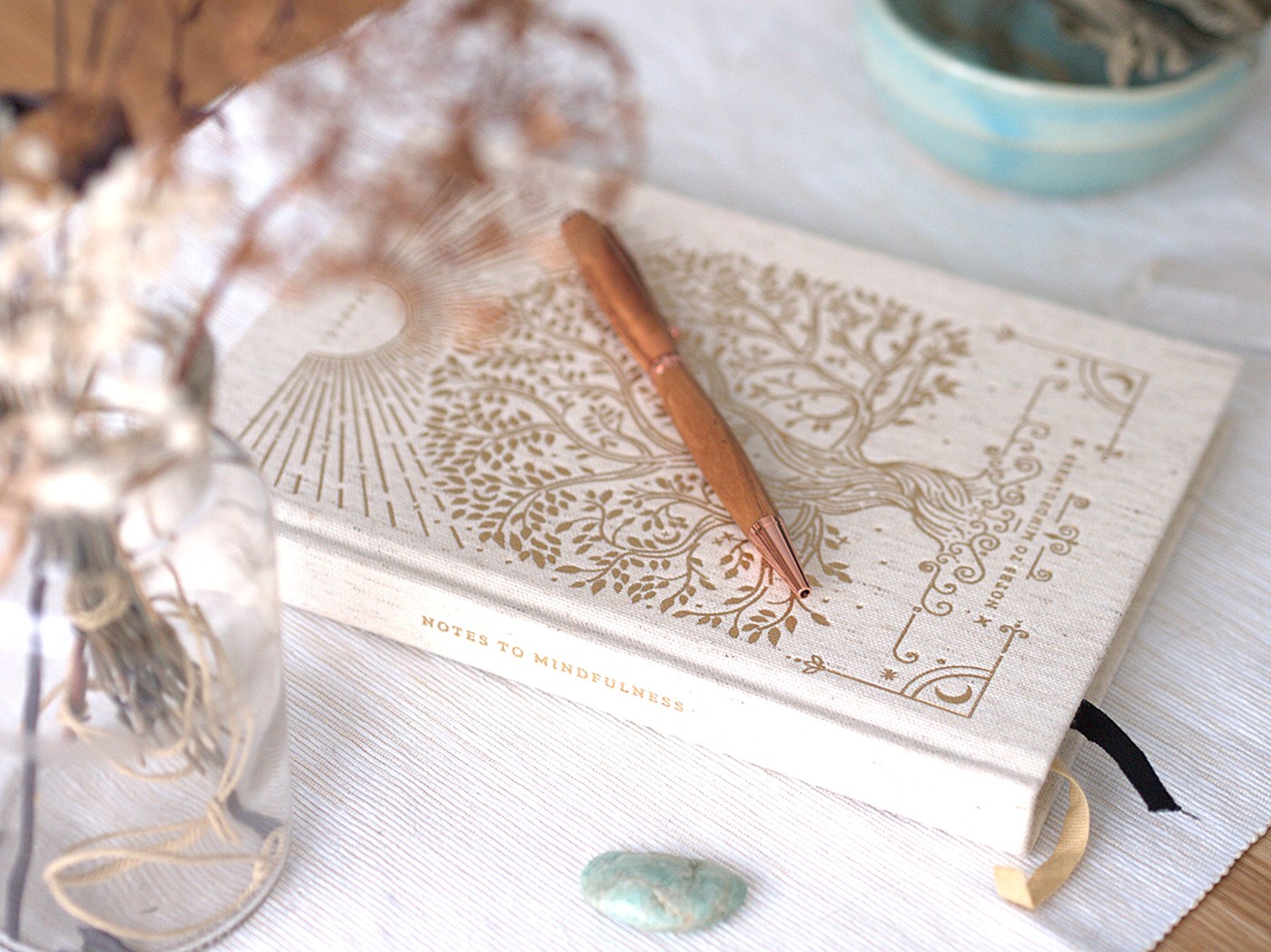
The month of February continues to cast its soft light across Winter Wonderland, gently melting mountains of snow and transforming the element of winter into rivers and muddy puddles showing that the earth is waking up. Brigid’s energy is everywhere, and I turn to her in her aspect as a goddess of poetry, invoking her blessings and hoping that she will lend her gifts to me as I take out my journals, notebooks and laptop to begin a new year of writing.
In ancient Ireland, Brigid was worshipped by the fili – professional poets tasked with preserving the genealogies of the ruling class and composing heroic tales to glorify the deeds of the warrior kings. Today, the term “poetry” narrowly refers to a genre of verse, but in ancient times it was synonymous with literature in general, which in turn, encompassed all writing that possessed aesthetic qualities: epic poems, history, myth, prayers and other sacred lore. The difference between a poet, scholar and priest was floating. In some Celtic traditions, the “Bard” appears along the more commonly known “Druid” as a separate rank within the priesthood. Like the fili, bards were poets and musicians who preserved the memory of great deeds of heroic rulers, battles, myths and folklore. Bards existed in many cultures (for example, see skald in the Norse tradition) and has been revived in popular culture through roleplaying games such as Dungeons & Dragons.
The Power of Words
The spoken and written word carried enormous power in the ancient and medieval world, and we are just beginning to understand anew how much language creates our reality. Modern psychology talks about the power of “programmed beliefs” and how the “stories” we tell ourselves determine how we view the world and experience our lives.
For most of human history, knowledge, especially of the written word, was extremely rare and those skilled in the intellectual arts were feared. To say something out loud was to manifest it, to create it. Think of the story of creation in the Gospel of John: “In the beginning was the word and the word was with God, and the word was God.” in the Greek version of the text, the term later translated as “the word” is logos – reason, or more broadly, the force of the intellect. Language is the force of creation, and speaking something out loud has consequences. This is where the belief in blessings and curses comes from, and why people who could read and write were regarded as dangerous wielders of magic. Grimoire, a concept that modern witches and pagans have picked up to label their spell books or spiritual journals is a distortion of the Latin Grammaria – grammar; the building blocks of language.
While spell books have existed since the dawn of human language, wrapped in mythological stories and religious ritual, what we call Grimoires are a product of medieval Europe. The classic Grimoire contained useful information on how to heal illnesses, invoke demons, improve one’s fortune in money and love, create talismans and other activities the Catholic Church didn’t want people dabbling in. It should be noted that there are other types of learned works of magic, especially from the period of the Renaissance, that where not intended to be hidden from the church’s eyes but to infuse Christianity with the esoteric elements of classical philosophy.
Writing and creativity has always been an integral part of magic and religion. When neo-paganism became truly popular in the modern era, around the 19th century, it was largely because poets and artists turned to the old gods and myths to find inspiration and meaning in a world that had been drained of spiritually as Christianity lost ground to modern science. By keeping a journal of your spiritual life or crafting a grimoire of spells, you’re partaking in an ancient practice that for most of human history was reserved for a small elite. Honor that.
My Grimoire and Journals
I keep several journals as part of my spiritual practice. A gratitude journal to support personal development, a grimoire which is reserved for artwork related to the wheel of the year, and a planner in which I write down spiritual goals for the year and month ahead, rituals, and any other information such as animal sightings, experiences from meditations etc. In addition, I have a notebook dedicated to poetry, a notebook for ideas for other creative projects and the list goes on…
The Art Journal
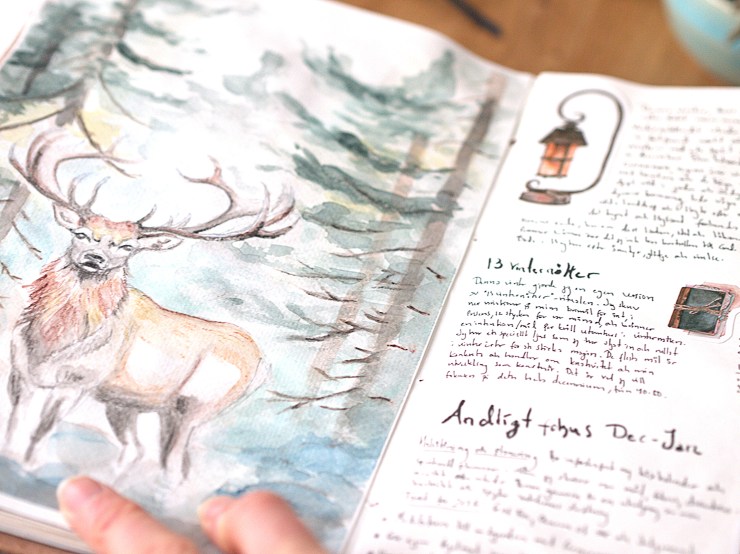
I always wanted to keep an illustrated journal so in 2022 I bought a beautiful leather sketchbook bound with with thick drawing paper to realize my dream. Back then I had only drawn sporadically when inspiration struck and I didn’t know the basics of sketching or any painting media, so for a couple of years, the art journal just sat on my desk as a source of frustration and a reminder of my lack of artistic capability. Then, one day in late December of 2024, I picked up some watercolors and just began painting. I dedicated most of my free time in 2025 to learning how to draw and paint and it was one of the best years of my life. I achieved a new level of focus and calm, experienced heightened presence and came to literally view everything around me differently, more intensely, by spending all this time alone with pen and paper. While drawing, you activate the right side of your brain, the intuitive area that recognizes patterns and relationships as opposed to the left side, which rules language and reasoning, so the activity itself forces you to still the endless rush of thoughts in your mind. As a bonus, people really like getting paintings as gifts, so it’s a nice way to show friends and family that you care.
During my year of painting I slowly learned that anyone can conjure up wonderful worlds of line and color on a piece of paper if they take the time to learn the skill properly. Drawing and painting takes time though, a lot more time than jotting down a few sentences about your day, so it helps to figure out how much artistic work you think that you can actually accomplish in a year and set the bar even lower. I’ve committed to one painting per Sabbat, along with a page of reflection, so that makes 2 pages 8 times a year, rather than trying to visually imagine everything I experience every day. The Sabbat paintings have become a central part of my wheel of the year celebrations and spiritual practice. Every drawing is a prayer and an honoring of the seasons.
The Spiritual Planner
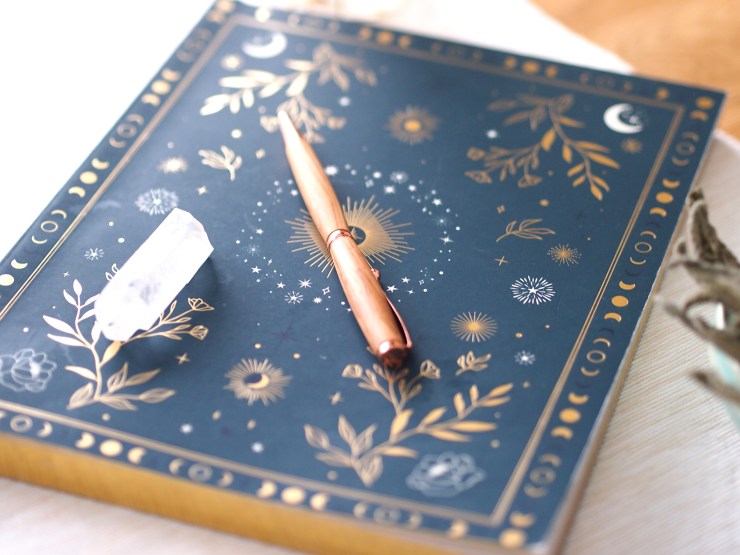
My spiritual planner is closer to a traditional grimoire, but I prefer to call it a planner because that’s what it is. In this lined notebook I keep track of the overarching spiritual and creative goals for the year and months ahead. Unlike the art journal, the planner is freed from any demands on beauty or creativity, it is simply a place to keep track of ideas. What you write about in your grimoire will depend on your own practice, but here are some ideas based on mine:
- Sabbat celebrations (seasonal decor, altar setups, spells, activities, correspondences)
- Garden plans (wildlife friendly trees and bushes, herbs, flowers and edibles for rituals, spells and seasonal living)
- Interpretations of animal sightings
- Tarot readings
- Spiritual and creative activities for each month
- Deity work (research on specific deities, creative activities and prayers/poetry to invoke their energy)
- Reflections on meditations and the manifestation of spells
- Random thoughts that seem important in the moment
Happy journaling!
Suggested Reading
Claude Lecouteux, The Book of Grimoiries: The Secret Grammar of Magic (2002, 2013)
Owen Davies, Grimoires: A History of Magic Books (2009)
Kristoffer Hughes, The Book of Druidry: A Complete Introduction to the Magic & Wisdom of the Celtic Mysteries (2023)
Lunaea Weatherstone, Tending Brigid’s Flame: Awaken to the Celtic Goddess of Hearth, Temple and Forge (2015)
Ronald Hutton: The Triumph of the Moon: A History of Modern Pagan Witchcraft (1999)


